Introduction
Want to maximize your DSA earnings? Then, getting DSA bank codes from multiple lenders is your best strategy.
However, many agents wonder how to get the DSA code from more than one bank.
Moreover, working with multiple banks increases your income potential significantly. Consequently, you can offer customers more loan options.
In this comprehensive guide, you’ll understand everything about the Direct Selling Agent bank code. Furthermore, you’ll learn the exact process to get codes from multiple banks. By the end, you’ll know how to build a diversified DSA portfolio.
What is a DSA Bank Code?
Before learning how to get a DSA bank code, let’s understand what it actually is.
Definition
A DSA code is a unique identification number assigned to you by a lender or a bank. Moreover, this code tracks all your activities, applications, and commissions. Therefore, it’s your official identity in the lender’s system.
Other Names
The Direct Selling Agent bank code is also called:
- DSA ID
- Partner Code
- Agent Code
- DSA Number
- Partner ID
- Referral Code
However, the most common term is DSA code or DSA bank code.
Purpose of DSA Bank Code
Transaction Tracking: Every loan application you submit carries your DSA code. Therefore, the lender knows which applications are yours.
Commission Calculation: Your code links to your commission account. Moreover, all earnings are tracked against this code.
Performance Monitoring: Lenders use your code to observe your performance. Additionally, they track approval rates and volumes.
Customer Attribution: When a customer applies through you, your code ensures you get credit. Consequently, you receive proper commission.
System Access: Your DSA code provides you access to the lender’s portal or app, where you can submit applications and track status.
Why Get DSA Codes from Multiple Banks?
Understanding how to get the DSA bank code for multiple banks is important. But first, let’s see why you should do it.
Benefits of Multiple DSA Bank Codes
1. Increased Income Potential
When you have multiple DSA bank codes, you can serve more customers. Moreover, you’re not limited by one lender’s products. Therefore, your earning opportunities increase.
2. Product Diversity
Different banks offer different loan products. Therefore, you can match customers with the best-suited lender. Additionally, this improves your success rate.
3. Better Customer Service
Some customers get rejected by one bank. However, they might get approved by another. Therefore, multiple codes mean you can try different options.
4. Risk Mitigation
If one bank changes commission rates or policies, you have backup options. Moreover, you’re not completely dependent on a single partnership.
5. Competitive Advantage
Offering options from multiple banks makes you more attractive to customers. Additionally, you can compare rates and choose the best deal.
6. Higher Approval Rates
Each bank has different eligibility criteria. Therefore, having multiple options increases overall approval chances significantly.
Can You Partner with Multiple Banks?
A common question is whether you can legally have multiple DSA bank codes. Let’s clarify this.
Yes! You can absolutely partner with multiple banks, NBFCs, and fintech companies simultaneously. Moreover, there are no legal restrictions on this.
Important Considerations
Check Exclusivity Clauses: Some lenders require exclusive partnerships. Therefore, read your agreements carefully. However, most lenders allow multiple partnerships.
Conflict of Interest: Avoid situations where one lender’s interest conflicts with another. Moreover, maintain professional ethics always.
Time Management: Managing multiple partnerships requires organization. Therefore, ensure you can handle the workload.
Quality Over Quantity: Having 10 codes but serving poorly is worse than having 3 and giving the best performance.
Types of Multiple Partnerships
Horizontal Diversification: Partner with banks, NBFCs, and fintechs. Therefore, you cover all lender types.
Vertical Diversification: Offer different loan types from different lenders. For example, home loans from Bank A, personal loans from Bank B.
Geographical Diversification: Partner with lenders strong in different regions. Consequently, you serve varied markets.
How to Get DSA Bank Code: Step-by-Step Process
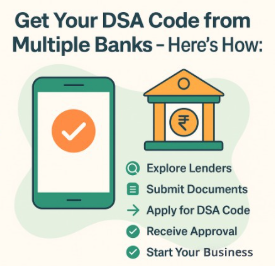
Now, let’s learn how to get the DSA bank code from multiple banks. The process is similar for each lender, but with minor variations.
Step 1: Research and Select Lenders
First, identify which banks or NBFCs you want to partner with. Moreover, don’t apply everywhere randomly without knowledge.
Selection Criteria:
- Commission Structure: Compare rates across lenders. However, don’t decide only on the commission. Consider approval rates, too.
- Product Range: Check what loan products they offer. Therefore, you can serve diverse customer needs.
- Eligibility Criteria: Ensure you meet their DSA requirements. Moreover, applying where you don’t qualify is a waste of time.
- Brand Reputation: Established brands are easier to sell. Additionally, customers trust known names more.
- Support System: Good lenders provide training and support. Furthermore, responsive teams make your work easier.
- Technology Platform: User-friendly apps and portals save time. Therefore, check their digital infrastructure.
Step 2: Prepare Documentation
Gather all required documents for DSA registration. Moreover, having everything ready speeds up the process.
Standard Documents Required:
| Document Type | Examples | Why Needed |
| Identity Proof | PAN, Aadhaar | Mandatory verification |
| Address Proof | Utility bills, Aadhaar | Residence confirmation |
| Educational Certificates | 10th, 12th, Degree | Qualification proof |
| Financial Documents | Bank statement, cancelled cheque | Commission payment setup |
| Photographs | Passport size | Application requirement |
| Contact Details | Mobile, Email | Communication |
Pro Tip: Create a master folder (digital and physical) with all documents. Accordingly, you can quickly submit to any lender.
Step 3: Apply to Each Lender
Now, start applying for your Direct Selling Agent bank code from each chosen lender.
Application Methods:
- Online Application:
- Visit the lender’s website
- Find the “Become a Partner” or “DSA Registration” section
- Fill online form
- Upload documents
- Submit application
- Offline Application:
- Visit the nearest branch
- Request the DSA application form
- Fill completely
- Attach document copies
- Submit to the designated officer
- Through Aggregators:
- Some platforms help you apply to multiple lenders
- However, verify their legitimacy first
- Commission splits may apply
Step 4: Complete Verification Process
After applying, each lender conducts background verification. Therefore, cooperate throughout the process.
- What Gets Verified:
- Identity and address
- Educational qualifications
- Credit history
- Criminal background
- Employment history (if applicable)
- Reference checks
- Your Role:
- Stay reachable on phone and email
- Respond promptly to queries
- Provide additional documents if asked
- Be patient during the process
Step 5: Sign Individual Agreements
Once approved, you’ll sign a separate agreement with each lender. Moreover, read each agreement carefully.
Key Things to Check:
- Commission Rates: Verify the percentages mentioned. Additionally, check payment terms.
- Territory: Understand your assigned area for each lender. Some may have overlapping territories.
- Products: See which products are covered. Moreover, check if the rates are the same for all products.
- Exclusivity: Confirm there’s no exclusivity clause. Therefore, you can maintain other partnerships.
- Termination Terms: Know the exit conditions. Additionally, understand notice periods.
Step 6: Receive Your DSA Bank Codes
After signing agreements, you’ll receive your unique DSA code from each lender. Moreover, note them down carefully.
How You Receive Codes:
- Via email
- Through SMS
- In the partner portal
- Physical letter (sometimes)
What to Do:
- Save all codes securely
- Don’t share with unauthorized persons
- Test login to each portal
- Verify the code is working
Step 7: Complete Training for Each Lender
Most lenders provide training to new DSAs. Therefore, attend training from each partner.
Training Coverage:
- Product details
- Eligibility criteria
- Documentation requirements
- Portal/app usage
- Compliance guidelines
Step 8: Start Working with Multiple Codes
Now you’re ready! You have multiple DSA bank codes. Therefore, you can start serving customers with diverse options.
Getting Started:
- Analyze each lender’s portal
- Comprehend their processes
- Submit test applications if possible
- Build your customer channel
Getting DSA Codes from Different Lender Types
The process to get the DSA bank code varies slightly by lender type. Let’s explore each.
A. Public Sector Banks
Characteristics:
- Stricter eligibility criteria
- Longer approval process
- Paperwork required
- Formal interview processes
How to Get DSA Bank Code:
- Visit the official bank website
- Download the DSA application form
- Submit with documents to the branch
- Wait for verification and approval
- Attend a formal interview
- Sign the agreement at the head office
- Complete training program
- Receive DSA code
Tips:
- Ensure a high credit score (700+)
- Have a graduation degree
- Prepare for formal processes
- Be patient with the timeline
B. Private Sector Banks
Characteristics:
- Moderate eligibility requirements
- Faster approval
- Digital application processes
- Professional approach
How to Get DSA Bank Code:
- Apply online through the website
- Upload documents digitally
- Complete online verification
- Attend a virtual or physical interview
- E-sign agreement
- Complete online training
- Receive code via email
Tips:
- Maintain a good credit score (650+)
- Use a professional email
- Be prompt in responses
- Leverage digital processes
C. NBFCs (Non-Banking Financial Companies)
Characteristics:
- Flexible eligibility
- Quick approval
- Minimal documentation
- Informal processes
How to Get DSA Bank Code:
- Apply through the website or app
- Basic document submission
- Quick verification
- Simple agreement signing
- Brief training or self-study
- Instant code generation
Tips:
- Even with lower credit scores, you can try
- Highlight your network and sales skills
- Be ready to start quickly
- Understand their niche products
D. Fintech Platforms
Characteristics:
- Very flexible criteria
- Instant to 7-day approval
- Completely digital process
- Modern approach
How to Get DSA Bank Code:
- Download their partner app
- Register with basic details
- Upload documents through the app
- Automated verification
- Digital agreement acceptance
- Video training modules
- Instant code generation
Tips:
- Be tech-savvy
- Complete app registration carefully
- Watch all training videos
- Understand digital loan processes
Common Challenges and Solutions
Working with multiple DSA bank codes brings challenges. However, each has a solution.
Challenge 1: Remembering Multiple Codes
Problem: You have 5-6 different codes and get confused about which to use.
Solution:
- Create a quick reference card
- Save codes in phone notes with lender names
- Use the master sheet
- Practice using codes regularly
Challenge 2: Managing Different Portals
Problem: Each lender has a different portal interface. Therefore, you waste time figuring them out.
Solution:
- Dedicate time to learn each portal entirely
- Create screenshot guides for yourself
- Use similar browsers/apps for consistency
- Practice during low-pressure times
Challenge 3: Inconsistent Requirements
Problem: Different lenders need different document formats. Moreover, processes vary significantly.
Solution:
- Create lender-specific document folders
- Prepare multiple format versions
- Use document templates when possible
- Stay organized from the start
Challenge 4: Commission Tracking
Problem: With multiple lenders, tracking commissions becomes complicated. You might miss payments.
Solution:
- Maintain a detailed commission tracker
- Set payment date reminders
- Negotiate regularly with the bank statements
- Follow up on delayed payments immediately
Challenge 5: Customer Assignment Difficulty
Problem: Deciding which customer goes to which lender. Moreover, customers want quick decisions.
Solution:
- Create a decision matrix based on eligibility
- Know each lender’s sweet spot
- Pre-qualify customers quickly
- Be transparent with customers about options
Challenge 6: Time Management
Problem: Managing multiple partnerships takes significant time. Therefore, you feel overwhelmed.
Solution:
- Start with 2-3 lenders initially
- Add more only when comfortable
- Use technology for efficiency
- Consider hiring assistance as you grow
Challenge 7: Maintaining Relationships
Problem: With many lenders, giving personal attention to each becomes difficult.
Solution:
- Schedule regular check-ins with each
- Respond promptly to all communications
- Provide consistent performance to all
- Don’t play favorites too obviously
Best Practices for Multiple Bank Partnerships
Follow these best practices when working with multiple DSA bank codes:
1. Start Small, Scale Gradually
2. Specialize by Lender
3. Maintain Transparency
4. Track Performance Metrics
5. Communicate Regularly
6. Follow Ethical Practices
7. Keep Learning
8. Document Everything
9. Balance Your Portfolio
10. Seek Win-Win Outcomes
Conclusion
Learning how to get the DSA bank code for multiple banks is essential for maximizing your DSA success. As we’ve covered, having multiple codes can seriously increase your income potential. Also, it provides flexibility and security.
Furthermore, remember that operating with multiple Direct Selling Agent bank codes requires organization. However, with the right systems and practices, it becomes manageable.
Therefore, start with 2-3 lenders and expand gradually.
Additionally, always maintain ethical practices across all partnerships. Quality service to all lenders ensures long-term success. Moreover, satisfied lenders often increase commission rates or provide better support.
So, don’t limit yourself to just one lender. Apply for multiple DSA bank codes today and multiply your earning potential!
Ready to expand your DSA business? Start applying for your second and third DSA bank codes now!
Frequently Asked Questions
Q1: Can I really have DSA codes from multiple banks?
Yes, absolutely! There are no legal restrictions on having multiple DSA bank codes. However, always check for exclusivity clauses in individual agreements.
Q2: How many DSA bank codes can I have?
There’s no fixed limit. However, practically managing more than 5-7 partnerships becomes difficult. Therefore, we recommend starting with 2-3 lenders initially. Then, expand as you gain experience.
Q3: Do I need separate documents for each bank?
No, you can use the same documents for all applications. However, each lender conducts independent verification. Therefore, keep multiple copies ready for submission.
Q4: Will having multiple codes affect my credit score?
No, registering as a DSA with multiple lenders doesn’t impact your credit score. However, they will check your score during the application. Therefore, maintain good credit regardless.
Q5: How do I decide which customer goes to which bank?
Match customers to lenders based on eligibility criteria, product usefulness, and approval likelihood. Moreover, consider which lender offers the best terms for that specific customer. Therefore, develop a quick assessment system.
Q6: Can I transfer my DSA code to someone else?
No, DSA bank codes are non-transferable. They’re assigned specifically to you. Moreover, any violations of this can result in termination of the partnership. Therefore, never share your codes.
Q7: What if two banks approve the same customer?
This situation requires ethical handling. If you submitted to both banks with customer knowledge, let the customer choose. However, ideally, apply to one bank first. Then, try others only if rejected.
Q8: How long does it take to get codes from multiple banks?
It depends on the lender types. You can get all codes within 1-2 months if you apply strategically. However, if applying only to public banks, it may take 3-4 months. Therefore, mix lender types for faster results.
Q9: Do all banks pay the same commission rates?
No, commission rates vary significantly. Some pay 0.5%, others pay 3-4%. Moreover, rates differ by product type. Therefore, compare carefully when selecting lenders.
Q10: What happens if one bank terminates my DSA code?
If one lender terminates your partnership, your other codes remain valid. This is actually why having multiple codes is beneficial. Moreover, you can continue earning through other partnerships. Therefore, diversification provides security.