
Introduction
Learning how to sell business loans effectively is essential for DSA success. Moreover, business loans offer higher commissions than personal loans. Accordingly, mastering business loan sales boosts your income.
Similarly, the business loan market in India is encountering rapid growth. Entrepreneurs constantly need funding for expansion and operations. Consequently, opportunities for DSAs are expanding every day.
However, selling business loans requires different skills than personal loans.
Moreover, you’re dealing with business owners who think differently. Therefore, understanding their mindset is essential.
This complete guide shares proven strategies for effectively making business loan sales. And, you’ll learn customer identification, pitching, and closing techniques. By the end, you’ll confidently sell business loans and increase conversions.
Understanding Your Product
Before learning how to sell business loans, you must understand what you’re selling. The product knowledge constructs confidence and credibility.
Key Product Features
- Loan Amount Range: Business loans typically range from Rs. 50,000 to Rs. 50 crores. Moreover, amounts depend on business turnover and requirements.
- Interest Rates: Rates vary from 12% to 24% annually. And, they depend on business vintage and credit score. Therefore, understand rate factors thoroughly.
- Tenure Options: Repayment periods range from 1 to 10 years. The longer tenures mean lower EMIs.
- Collateral Requirements: Some loans need security, others don’t. Secured loans offer better rates. Therefore, know both options thoroughly.
How to Sell Business Loans Effectively?
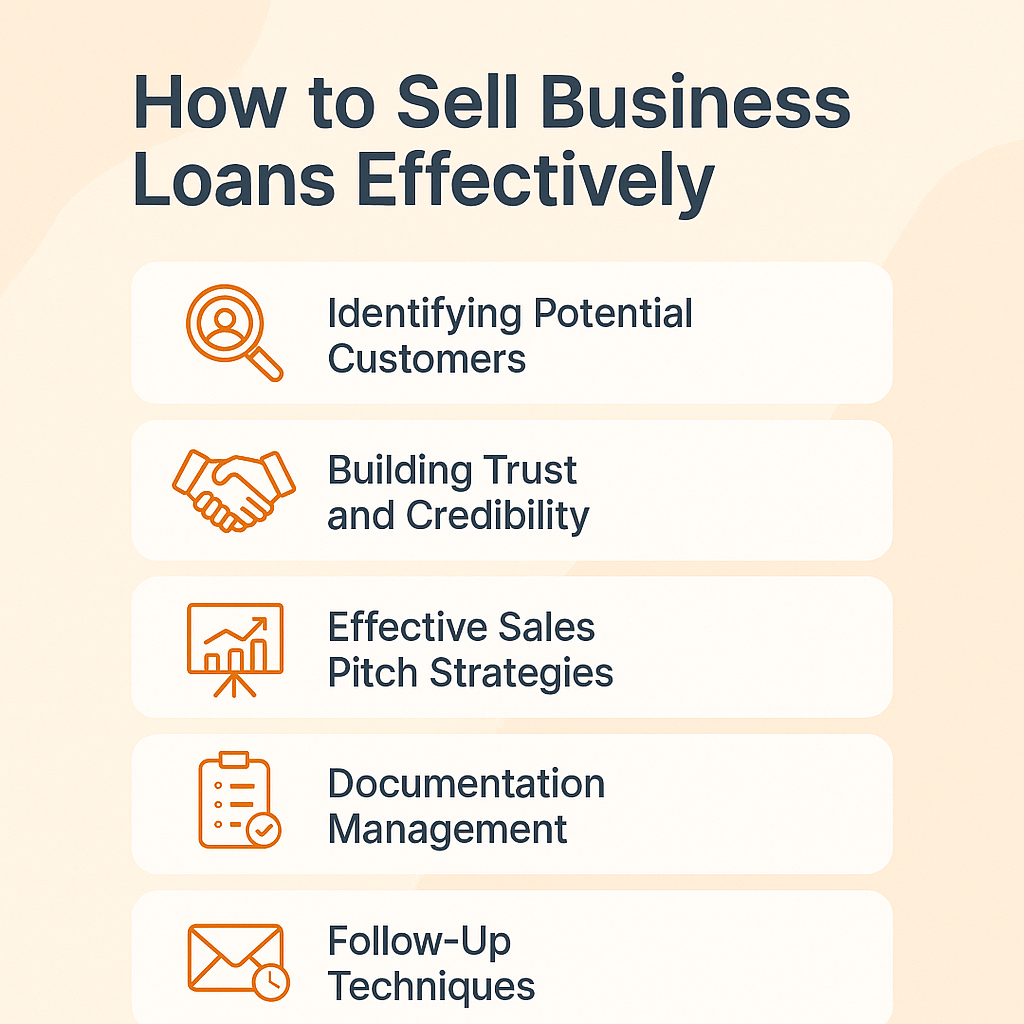
Identifying Potential Customers
Effective business loan sales start with finding the right customers. Moreover, targeting correctly saves time and increases conversions.
Customer Profiles
| Customer Type | Characteristics | Loan Need | Approach |
| Growing Businesses | 2-5 years old, expanding | Working capital, expansion | Highlight growth opportunities |
| Established Enterprises | 5+ years, stable | Equipment, new branch | Focus on competitive rates |
| Seasonal Businesses | Retail, agriculture | Inventory funding | Emphasize cash flow solutions |
| Startups | Less than 2 years | Initial capital | Offer flexible options |
Where to Find Customers
- Local Markets
- Trade Associations
- Networking Events
- Referrals
- Social Media
Building Trust and Credibility
Trust builds the foundation of effective business loan sales. And, business owners are careful with financial decisions. Therefore, establishing credibility is necessary.
Professional Presentation
- Dress Appropriately: Wear formal business attire when meeting customers. Moreover, appearance creates first impressions. Therefore, dress professionally.
- Carry Proper Materials: Have business cards, brochures, and calculators ready. Also, use a professional folder or bag.
- Use Professional Communication: Speak clearly and confidently. Avoid slang or casual language and speak clearly with confidence.
Demonstrating Expertise
- Know Your Numbers: Understand interest calculations and EMI computations.
- Share Success Stories: Tell about businesses you’ve helped. However, maintain client confidentiality.
- Understand Their Industry: Research the customer’s business sector. Moreover, ask intelligent questions about their operations.
- Be Honest: Never promise what you can’t deliver. Moreover, admit when you don’t know something. Therefore, long-term trust develops.
Effective Sales Pitch Strategies
Mastering your pitch to sell business loans is essential and helps in successful sales.
Initial Conversation Framework
- Start with Questions: Begin by asking about their business, listen actively to their responses, and understand their actual needs.
- Identify Pain Points: Discover their current challenges. You’ll find loan opportunities naturally.
- Present Solutions: Show how business loans solve their specific problems. Customize benefits to their situation.
- Use Numbers: Demonstrate with factual examples and calculations. Show potential returns on investment.
The AIDA Framework
- Attention: Start with an interesting business statistic or question. Therefore, you grab their focus immediately.
- Interest: Share how other businesses grew with loans. Moreover, relate examples to their situation.
- Desire: Explain specific benefits they’ll enjoy. Paint a picture of business growth.
- Action: Provide clear next steps and create urgency. Moreover, make the process seem simple. Therefore, they commit quickly.
Consequently, structured pitches improve conversion rates.
Customization is Key
- For Retailers: Emphasize inventory funding and seasonal support. Highlight quick approval times. Therefore, it matches their urgent needs.
- For Manufacturers: Focus on equipment financing and expansion. Additionally, longer tenures are available. Therefore, large investments become manageable.
- For Service Businesses: Highlight working capital and employee costs. Moreover, emphasize flexible usage.
Documentation Management
Proper documentation is crucial for business loan sales success. Moreover, incomplete paperwork causes most rejections. Therefore, managing documents efficiently is necessary.
Document Checklist System
Create category-wise checklists:
A. Business Documents:
- Registration certificates
- GST registration
- Financial statements (2-3 years)
- Bank statements (12 months)
- IT returns (2-3 years)
B. Property Documents (if applicable):
- Ownership proof
- Property papers
- Valuation reports
C. Personal Documents:
- Identity proofs
- Address proofs
- Income proofs
Follow-Up Techniques
Consistent follow-up is essential for effective business loan sales. Moreover, business owners, Consistent follow-up is important for effective business loan sales. Moreover, business owners are busy people. Therefore, continued communication is necessary.
Multi-Channel Approach
- Phone Calls: Best for urgent matters and closing. Moreover, personal touch is strong.
- WhatsApp: Good for quick updates and documents. Suitable for customers. Therefore, use it frequently.
- Email: Professional for sending detailed information. Moreover, creates documentation. Therefore, use for formal communication.
- Personal Visits: Powerful for building relationships. Additionally, shows commitment. Therefore, visit when progress stalls.
Therefore, various forms of communication keep engagement high.
Common Mistakes to Avoid
Learning from mistakes accelerates your success in business loan sales. Moreover, avoiding common mistakes saves time and effort.
Mistake 1: Not Qualifying Properly
Problem: Wasting time on unqualified leads.
Solution: Ask qualifying questions upfront. Moreover, verify basic eligibility before proceeding.
Mistake 2: Over-Promising
Problem: Making commitments you can’t keep.
Solution: Be realistic about timelines and terms.
Mistake 3: Ignoring Follow-Up
Problem: Losing interested prospects due to poor follow-up.
Solution: Maintain systematic follow-up schedules. Moreover, use CRM (Customer Relationship Management) tools if possible.
Mistake 4: Poor Documentation
Problem: Applications are getting rejected due to incomplete papers.
Solution: Create extensive checklists. Moreover, review documents before submission.
Mistake 5: Not Understanding Customer Business
Problem: Offering irrelevant solutions.
Solution: Research the customer’s industry and specific needs. And, customize your pitch accordingly.
Mistake 6: Pushing Too Hard
Problem: Aggressive selling pushes customers away.
Solution: Focus on consultation, not selling. And let customers decide at their own pace.
Mistake 7: Neglecting Existing Customers
Problem: Focusing only on new customers.
Solution: Stay in touch with past customers. Moreover, they bring repeat business and referrals. Therefore, maintain relationships actively.
Conclusion
Mastering how to sell business loans effectively requires dedication and a strategic approach. Successful business loan sales involve multiple elements working together.
Furthermore, remember that business loan sales are relationship-driven. Therefore, focus on long-term partnerships, not just transactions. And, genuinely help businesses grow with suitable financing.
Additionally, continuously improve your skills through practice and learning. Study successful case studies and learn from rejections. Stay updated on market trends and lender policies.
Consequently, these strategies, combined with consistent effort, will make you a top performer in business loan sales. Therefore, execute these techniques starting today.
So, identify your first business prospect and apply these principles. Track your results and refine your approach.
Here’s an exciting earning opportunity for you with WeRize Business loans. Now it’s your turn to become a trusted financial advisor in your community. You’re not just processing loans; you’re enabling businesses to grow, helping entrepreneurs achieve their dreams. This product is your gateway to helping business owners unlock growth capital while building a strong income stream for yourself.
Frequently Asked Questions
Q1: How to sell business loans to new businesses?
Focus on lenders with adjustable criteria for startups. Additionally, help prepare strong business plans. Therefore, approval chances enhance despite a limited history.
Q2: What’s the best approach for business loan sales?
Begin by thoroughly understanding the customer’s business and needs. Moreover, position yourself as a consultant, not a salesperson. And, provide customized solutions with clear benefits.
Q3: What commission can I expect on business loans?
The commission typically ranges from 1% to 3% of the loan amount. Therefore, on a Rs. A loan of Rs. 50 lakh, you earn Rs. 50,000-1,50,000.
Q4: How to handle rejection in business loan sales?
Understand the rejection reason first. See if another lender might approve. And, help customers improve weak spots for future applications.
Q5: How many prospects should I contact daily?
Aim for 5-10 meaningful business conversations daily. Moreover, focus on quality over quantity. Additionally, maintain proper follow-up with existing prospects.
Q6: What’s the biggest challenge in business loan sales?
Documentation and verification requirements are often challenging. However, helping customers prepare systematically overcomes this.